

Change in Licence Policy for CAAS Journals
We would like to inform you that the journals published by the Czech Academy of Agricultural Sciences (CAAS) will change their licence policy. All articles submitted to CAAS journals from 2026 will be published under the Creative Commons Attribution 4.0 International Licence (CC BY 4.0).
The Creative Commons Attribution 4.0 International Licence (CC BY 4.0) allows broad reuse, distribution, and adaptation of published articles, provided that appropriate credit to the original authors is given.
Articles submitted by 2025 are distributed under the Creative Commons Attribution-NonCommercial 4.0 International (CC-BY-NC 4.0) license.
Journal of Forest Science
- ISSN 1212-4834 (Print)
- ISSN 1805-935X (On-line)
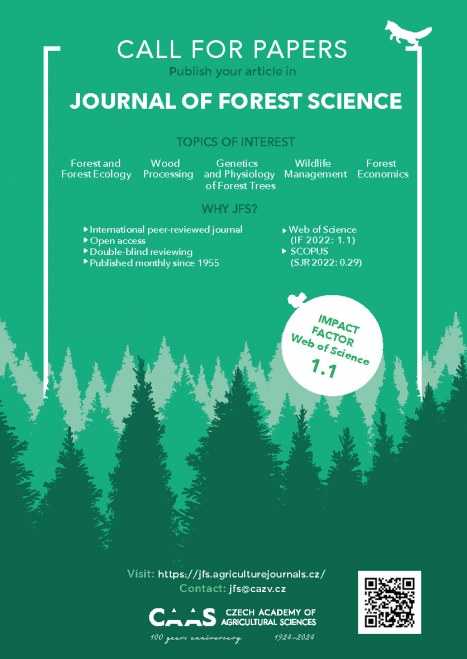
An international open access peer-reviewed journal published by the Czech Academy of Agricultural Sciences and financed by the Ministry of Agriculture of the Czech Republic. Published since 1955 (by 1999 under the title Lesnictví-Forestry)
- Editor-in-Chief: prof. Ing. Vilém Podrázský, CSc.
- Co-editors: doc. Ing. Radek Pokorný, Ph.D., prof. Ing. Vladimír Gryc, Ph.D.
- Executive Editor: Mgr. Ilona Procházková
- The journal is published monthly
Aims & Scope
Original results of basic and applied research from all fields of forestry related to European forest ecosystems and their functions including those in the landscape and wood production chain are published in original scientific papers, short communications and review articles. Articles are published in English.
Current issue
Morpho‑physiological traits and biomass scaling of the invasive Callery pear (Pyrus calleryana Decne.)Original Paper
Prabina Sharma, David R. Coyle, James F. Palmer, Nilesh Timilsina, Jessica Hartshorn
J. For. Sci., 2026, 72(9):441-454 | DOI: 10.17221/49/2026-JFS 
Accurately estimating aboveground biomass (AGB) of invasive plant species is essential for understanding their prevalence, ecological impacts, and informed management strategies. Pyrus calleryana (Callery pear) is established throughout the eastern United States, yet species-specific biomass models and physiological trait data remain limited. We destructively sampled 40 single-stem trees with diameter at breast height (DBH) ranging from 1.2 cm to 17.7 cm and height from 1.6 m to 10.3 m across six sites in South Carolina to quantify dry biomass, moisture content (MC), Carbon and Nitrogen ratios (C : N),...
Simulated bark stripping reduces stem growth in young Norway spruce: Evidence from continuous dendrometer monitoringOriginal Paper
Zdeněk Vacek, Stanislav Vacek, Jan Cukor, Veronika Hammerová, Jakub Černý, Václav Šimůnek, Richard Ševčík, Kateřina Brynychová, Václav Trojan, Jan Budínský
J. For. Sci., 2026, 72(9):455-468 | DOI: 10.17221/71/2026-JFS
Norway spruce [Picea abies (L.) Karst.] is Europe's most important commercial tree species, whose stability, vitality, and production potential can be significantly compromised by cervids. Their populations in Europe have been growing over time. This study aimed to analyse the effect of simulated circumferential trunk damage – mimicking bark stripping by ungulates – on the diameter growth of young spruce trees through continuous measurements with point dendrometers at 15-minute intervals. Dendrometers were installed at two permanent research plots (PRPs) in the Lužické hory (Lusatian Mountains) and at another two PRPs in the...
EU Deforestation Regulation, timber theft and illegal logging in Czech judicial practiceOriginal Paper
Petra Hlaváčková, Martin Cempírek
J. For. Sci., 2026, 72(9):469-482 | DOI: 10.17221/67/2026-JFS
This study evaluates the potential of the European Union Deforestation Regulation (EUDR) to reduce timber theft and illegal logging through an analysis of Czech judicial practice. A qualitative content analysis of publicly available court decisions concerning illegal harvesting, timber theft and related forms of forest crime was conducted. The identified crime mechanisms were subsequently assessed against EUDR requirements concerning geolocation, due diligence, risk assessment and supply-chain traceability. The results show that illegal harvesting is a multi-stage process involving the selection of vulnerable forest properties, creation of apparent...
Cross-scale assessment of pigment differences between healthy and bark-beetle-damaged Norway spruce stands using UAV and airborne hyperspectral imageryOriginal Paper
Adenan Yandra Nofrizal, Lucie Červená, Jakub Lysák, Zuzana Lhotáková, Kristýna Štěpánová, Jana Albrechtová, Lucie Kupková
J. For. Sci., 2026, 72(9):483-499 | DOI: 10.17221/61/2026-JFS
Chlorophyll and carotenoid content provide information on forest canopy condition and may reveal biochemical differences associated with disturbance. However, it remains uncertain whether these differences can be consistently detected from hyperspectral observations acquired at different spatial scales. We assessed pigment differences between two contrasting Norway spruce [Picea abies (L.) Karst.] reference stands: one without visible crown damage and one disturbed following bark beetle infestation in Krkonoše National Park, Czechia. The study combined 54 biochemical needle samples from 18 trees and simultaneous UAV Headwall Nano-Hyperspec®...
Corrigendum: Microclonal propagation of Cotoneaster melanocarpus as a tool for ecosystem restoration and resilience in KazakhstanCorrigendum
Yedil Aishuk, Dani Sarsekova
J. For. Sci., 2026, 72(9):500 | DOI: 10.17221/79/2026-JFS
Corrigendum